

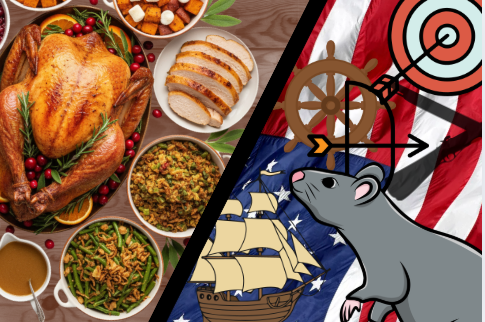
The story of the first Thanksgiving is a fairy tale. One where the friendly pilgrims dock the Mayflower on indigenous land, the native people welcome them with open arms, and they all eat turkey together. The end.
However, the reality is significantly more disturbing. This “first Thanksgiving” we’re all so accustomed to is really a marker of the beginning of cultural genocide and mass displacement of the indigenous people. The settlers who arrived on the Mayflower carried with them deadly diseases, religious controversy, and ideals of cultural superiority. These racist ideals of white and Christian superiority snowballed into the Indian Removal Act, Indian Boarding Schools, and general abuse and murder of thousands of native people. The first Thanksgiving is a ridiculously romanticized and inaccurate portrayal of the brief political truce that occurred between the Puritans and indigenous people before it all went wrong. This is what we’re celebrating, choosing to ignore the brutality and heinous history of the holiday.
First of all, the settlers brought with them a deadly disease that, according to American History Central, was likely leptospirosis. This epidemic, known as the Great Dying, ended up wiping out about 90% of the nearby native population in the span of about three years.
The Puritans then ended the ephemeral truce between them and the native people by selling several of their people as slaves without their knowledge and then against their will once they found out. Once they were unable to sell anyone else, the settlers began to force Christianity onto the indigenous people, establishing principles of white superiority that sparked the Europeans’ next brilliant idea: Indian Boarding Schools.
The first Indian Boarding School was opened in 1819, intended to culturally assimilate native americans into the dominant white culture. As written by Britannica, these Indian Boarding Schools were well-known by the slogan, “Kill the Indian…and save the man.” Hundreds of thousands of children attended these schools, intended to break ties between the kids and their family, culture, and heritage. Most of these children were forcibly ripped from their homes and forced to attend these schools, and a new investigation has revealed that many of these schools were sexually abusing children.
Around the same time, the Indian Removal Act was put into place. In 1830, the law was passed, intended to kick indigenous people off of the more desirable land so white men could have it. Some tribes went peacefully, but several fought back, leading to the forced removal of native people onto designated “reservations”. This forced removal became known as the Trail of Tears, on which thousands of native americans died, according to National Geographic.
This year, hundreds of millions of Americans celebrate Thanksgiving and reminisce about the friendly pilgrims who shared turkey with the native people. Today, the holiday is more centered on gratitude and community rather than the story of the first Thanksgiving, but it is still worth considering what it really signifies.
At it’s core, Thanksgiving is a story of ethnic cleansing, cultural assimilation, mass violence, and genocide. This is the holiday that is being celebrated in the 21st century, not one of joy, peace, and friendship, but one of abuse, casualty, and deep pain.
So why are we rejoicing over thousands of people’s pain and suffering? Families planning on celebrating Thanksgiving this year will spend an average of $952 on holiday-related expenses. In tandem with Black Friday, Thanksgiving pulled in $16.9 billion in online sales in 2024, according to ABC News. The first Thanksgiving was designed to capitalize on nostalgia, sanitizing the harsh truths that come with the narrative. This is why we still accept Thanksgiving as a holiday: not because we’ve decided to recognize the atrocious reality of the story and focus on gratitude and family instead, but because America is so commercially driven that we refuse to trade in profit for truth.